Winter Night Walks: How to Keep Your Dog Visible
Updated : November 14, 2026
To stay visible with your dog on a winter evening walk, you need both light AND reflective gear, on your dog and on you: a light-up collar or harness so your dog can be spotted from a distance, a reflective leash, light-coloured clothing or a vest for you, and a well-lit route on the sidewalk. One of these alone is not enough, because a driver has to see the owner, the leash and the dog.
Why the evening walk gets riskier in winter
In Quebec, once the clocks fall back in early November, darkness comes early. Around the winter solstice, the sun sets at about 4:15 p.m. in Montreal, and even earlier in many regions. The after-work walk that happened in daylight in September now happens in the dark, at rush hour.
Several things work against you at this time of year:
- Snow and slush dirty clothing, headlights and windshields, which cuts down what drivers can see.
- Snowbanks hide a small dog and sometimes force you to walk closer to the street.
- Dark winter coats, yours and your dog's, blend into the night.
- Your dog sees better in the dark than you do. The American Kennel Club (AKC) explains that dogs' eyes pick up low light and movement better than ours. Your dog will often react before you do to a hare, a cat or another dog, and may lunge suddenly.
Our picks
Here are two popular, well-rated light-up products designed to be seen from far away on evening walks.
Making your dog visible
The light-up collar or harness
This is the most effective gear. An LED light can be seen from far away, even where there are no streetlights, while reflective material only shines when headlights hit it. Zoetis Petcare's night-walking tips recommend LED collars, harnesses or leashes, some of which can flash.
How to choose:
- USB rechargeable rather than battery-powered: in winter you use it every day, and cold drains batteries faster. Keep the charger by the front door so you don't forget.
- Light all the way around the neck or body, not just a single point, so drivers can see the dog from the side, front and back.
- A harness rather than a collar for long-haired dogs. Zoetis notes that a collar is harder to see from behind and can get lost in thick fur. A lit harness or vest covers more surface.
- Steady mode draws less attention from other dogs than flashing mode; flashing is useful near busy streets.
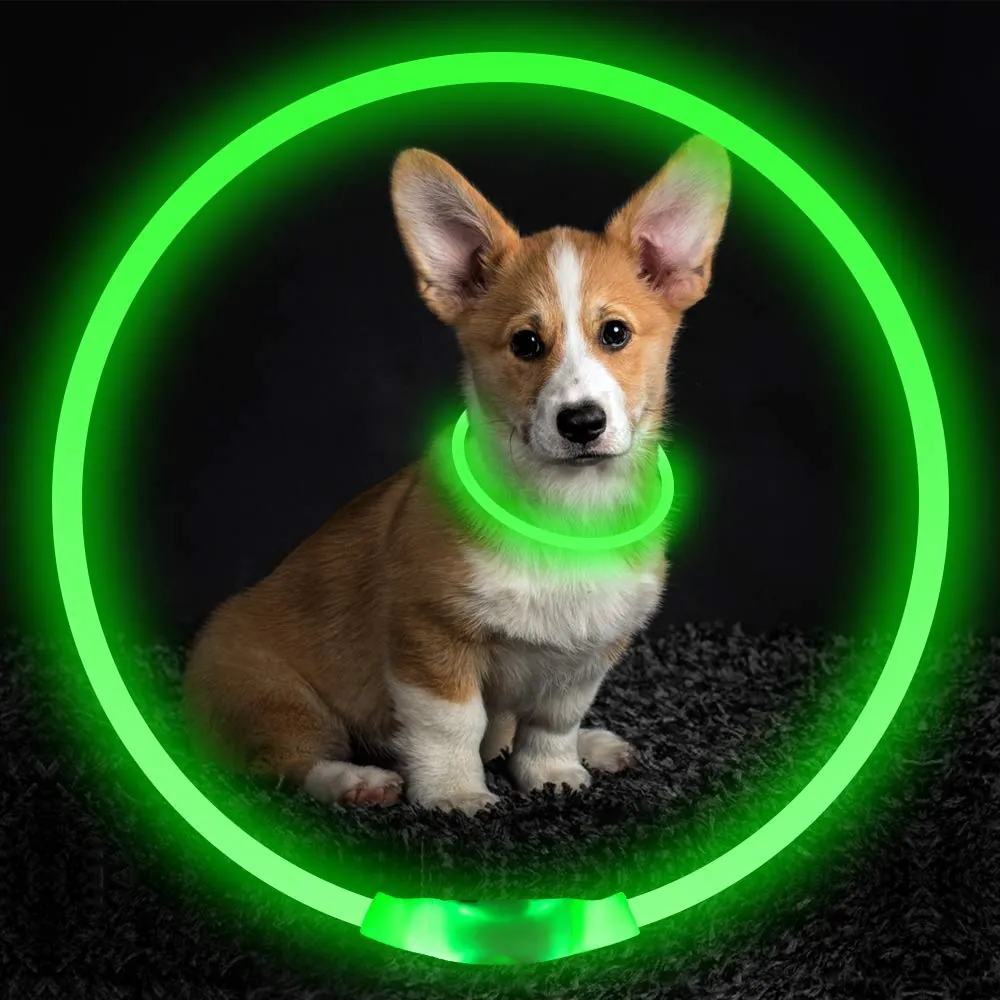 Our pickUSB rechargeable light-up dog collarA light-up collar that recharges by USBfrom $16.99See the product ›Sponsored
Small dogs and winter coats
A small dog easily slips under a driver's line of sight, especially next to a snowbank. If your dog wears a winter coat, pick a bright colour with reflective strips and add the light on top, on the harness. To find out whether your dog needs a coat, read our guide Does my dog need a winter coat?.
The ID tag
In the dark, a dog that slips its leash gets lost faster. A tag with your phone number, securely attached to the collar, is still the basic step. If your dog tends to run off, a GPS tracker can help: see how to choose a GPS tracker for dogs.
The right leash for evenings
The AKC suggests a leash with reflective materials if you often walk near traffic after dark. It also points out that the thin cord of a retractable leash is hard to see at night. That is a real hazard: a cyclist or pedestrian can pass between you and your dog without seeing the line.
For evening walks in town, choose:
- A fixed 4 to 6 foot leash (1.2 to 1.8 m), reflective or lit.
- A traffic handle close to the dog, which the AKC mentions for keeping your dog right beside you when crossing a street.
- Gloves that grip the leash. In thick mittens, it is easier to drop the leash when your dog pulls suddenly on ice.
Our guide Which leash is best for my dog? compares the options, and our article on the best harness for a dog that pulls helps if icy walks turn into waterskiing.
Make yourself visible too
Your dog may glow like a Christmas tree, but drivers will often see you first. Zoetis Petcare recommends reflective clothing that shows from all sides, or a reflective vest worn as the outer layer. Dark clothing blends into the night and the wet pavement.
Simple ideas for a Quebec winter:
- A reflective vest over your winter coat, or reflective bands on your arms and ankles, where the movement is.
- A headlamp: it makes you visible and lights up icy ground, holes, and whatever your dog is trying to eat in the snow.
Pick the right route
Gear does not replace a good route. Here are the essentials, based on Zoetis Petcare's advice:
1. Choose a well-lit route with streetlights, one you know in daylight.
2. Stay on the sidewalk. Zoetis advises using sidewalks when they are available. When the sidewalk is buried in snow, pick another street rather than walking in the lane.
3. Avoid wooded trails after dark: holes, branches and wildlife are hard to see there.
4. Keep your dog on a leash. Zoetis reminds owners that coyotes and raccoons are most active at night, dusk and dawn.
5. Cross at intersections, keep your dog close, and never assume a driver has seen you.
A fenced, lit dog park is a good way to let your dog burn off energy with no traffic around. Many Quebec towns have one: find one near you in our dog parks section.
Stay alert
Evenings bring more distractions and less visibility. Zoetis reminds walkers to keep looking and listening, and never to rely on others to see them:
- No headphones, no phone in hand. You need to hear a car backing up, a bike or a dog approaching.
- A charged phone in your pocket for emergencies.
- Poop bags, even at night. Snow doesn't make the problem go away: it comes back in spring.
If your schedule doesn't allow a daylight outing, a dog walker can take care of the midday walk during the darkest months. Find one in our dog walkers and pet sitters section.
A quick routine before you head out
Keep everything in one spot by the door so nothing gets forgotten:
- The charged light-up collar or harness and the reflective leash.
- Your vest or headlamp.
- Bags, and a towel to wipe paws when you get back.
- Booties, if your dog wears them. De-icing salt is hard on paw pads: see our article on road salt and winter paw care.
Turn on your dog's light before you open the door: driveways, with neighbours backing out, are where a dog most often goes unseen.
Frequently asked questions
Is reflective gear enough, or do I need a light?
Reflective material only shines when headlights hit it, and only back toward those headlights. An LED light can be seen from every direction, even on a dark street. Having both is best.
Will flashing mode bother my dog?
Most dogs get used to it quickly. Flashing can draw other dogs' attention, though. Use it mostly near busy streets and steady mode elsewhere.
Can I use a retractable leash in the evening?
It is not ideal. The thin cord is hard to see in the dark, and it lets your dog drift toward the street. A fixed reflective 4 to 6 foot leash is safer in town.
How often should I charge a light-up collar?
Depending on the model, a charge lasts from a few hours to about a dozen. In winter, recharge it after each day of walks and keep the charger near the door.
Sources
- Dogs' Night Vision: Why Dogs See Better in the Dark Than We Do, American Kennel Club
- Dog Leashes 101: Choosing the Right Dog Leash for Your Dog, American Kennel Club
- Winter Preparedness and Keeping Yourself, Family and Dogs Safe, American Kennel Club
- Safety Tips for Walking Your Dog at Night, Zoetis Petcare
Find a service near you
Dog park Dog walkers and pet sitters Pet food & supply stores Search by city