Which leash is best for my dog?
Updated : November 10, 2026
For most dogs, the best leash is a standard fixed-length leash of about 4 to 6 feet (1.2 to 1.8 m), in nylon or leather, wide enough for the dog's size. That is the tool the American Kennel Club (AKC) and VCA Animal Hospitals recommend for everyday walks and for learning loose-leash walking. In Quebec it is also the rule: in a public place, the leash may not be longer than 1.85 m. Retractable leashes and long lines have their uses, but only in specific situations.
What the law says in Quebec
The provincial dog regulation applies everywhere in Quebec, and your municipality can add its own rules. According to Québec.ca:
- A dog must be kept on a leash in public places, except in a dog exercise area (dog park) or during a canine activity.
- The leash may be no longer than 1.85 m.
- A dog weighing 20 kg or more must have its leash attached to a harness or a head halter, not just a collar.
In practice, a retractable leash extended to 5 m on a sidewalk does not meet this rule. A 1.8 m standard leash works everywhere. Check your city's bylaw too: some require a licence tag or ban dogs from certain parks.
Our picks
Three leashes from well-known, highly rated brands, one for each use.
The standard leash: the basic choice
This is the classic single-length leash with a handle at one end and a clip at the other. The AKC describes nylon versions as affordable, strong, easy to clean and waterproof. Many trainers start leash training with a 4- to 6-foot leash because it gives the dog some freedom while keeping consistent control.
VCA Animal Hospitals adds that a short, sturdy leash lets you retreat quickly if you meet a loose dog or wildlife. To hold it securely, slip your hand through the handle and wrap the leash around your palm so it cannot slide out of your fingers if your dog lunges.
Choosing the length
- 4 feet (1.2 m): handy in the city, on busy sidewalks or at the vet.
- 6 feet (1.8 m): the best everyday compromise, and the maximum allowed in public in Quebec.
Choosing width and material
According to the AKC, small dogs are more comfortable with a narrow, lightweight leash, while large dogs, dogs that pull and dogs still in training need a wider, sturdier one.
- Nylon: light, inexpensive, washable and quick to dry. Ideal for rain and snow.
- Leather: comfortable in the hand and durable. Clean it with a damp sponge and leather conditioner rather than soaking it.
- Rope (climbing style): very strong and comfortable, often with a padded handle.
- Chain: useful for a dog that chews fabric leashes, says the AKC. Heavier, so better for large dogs.
Small details that matter
- A padded handle prevents leash burn when the dog pulls.
- A traffic handle (a second loop near the clip) keeps the dog close in crowds, at intersections or when passing another dog.
- Reflective stitching helps drivers see you on evening walks, which are common during Quebec winters.
- A strong swivel clip keeps the leash from twisting.
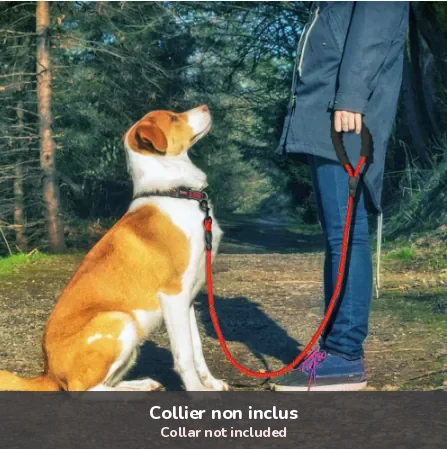 Our pickReflective rope leashA fixed rope leash, reflectivefrom $16.99See the product ›Sponsored
The retractable leash: use with care
A retractable leash extends and rewinds on its own, and it can be locked at a chosen length, up to about 30 feet (9 m). The AKC lists several risks:
- It rewards pulling: the more the dog pulls, the more leash it gets, so it is a poor choice for a dog that has not learned to walk without pulling.
- The dog can be hurt if it hits the end of the line at full speed.
- Extra length reduces your control: the dog can reach another dog, a pedestrian or the street before you can react.
- A dropped handle clatters along behind the dog, which can frighten it and make it run.
- Thin cords are hard to see at night and can burn or cut skin if they wrap around a leg. Never grab the cord while the dog is moving.
VCA Animal Hospitals says it can work for quick bathroom breaks but is not the best restraint for exercise.
If you still want one
The AKC suggests choosing a flat tape rather than a cord, ideally bright or reflective, a comfortable non-slip handle and a reasonable length (16 feet is the most common). Your dog should first walk politely on a standard leash and know basic cues such as "leave it," "watch me" and a reliable recall. Keep it for an unfenced yard or a wide open space with nobody around, and lock it at 1.85 m or less on sidewalks.
Avoid retractables in pet stores, at the vet, in crowds, where there are many dogs and on sidewalks, where the line can wrap around poles or hydrants.
The long line: for recall training
A long line is a simple leash of 10 to 30 feet or more. Unlike a retractable, it does not rewind: you let it out and gather it back by hand. The AKC recommends it for recall practice and for letting puppies explore safely.
VCA Animal Hospitals suggests starting with a 10- to 15-foot line and going longer only if you want to train over a larger radius. Think of it as a safety belt, not a way to pull the dog: keep some slack and practise in a fenced area first.
Attach it to a harness rather than the collar, wear gloves and never wrap it around your hand or wrist.
Remember that the 1.85 m rule applies in public. A long line is mainly for private land, large grounds where it is allowed, or a dog exercise area during quiet hours.
Leash, collar or harness?
The leash is only half the equipment. For a dog that pulls, a front-clip harness helps a lot, and in Quebec a harness or halter is required for dogs of 20 kg or more. Read our article Best harness for a dog that pulls for more. Either way, VCA recommends keeping an ID tag with the dog's name and your phone number on the collar.
Which leash for which dog?
- Puppy: a light 6-foot leash for walks; a 10- to 15-foot long line in the yard for recall.
- Small dog: a narrow, light leash with a small clip that does not weigh on the neck.
- Large dog or puller: a wide, sturdy leash with a padded handle and a traffic handle, attached to a harness.
- Calm, well-trained dog: a standard leash on sidewalks; a retractable is possible in a large empty space.
- Evening walks: a reflective leash and a light on the collar, as VCA advises.
If your dog pulls hard or reacts to other dogs, a few sessions with a dog trainer often make a big difference.
Frequently asked questions
Are retractable leashes allowed in Quebec?
Yes, but in public the leash may not exceed 1.85 m. A retractable must therefore be locked at that length or shorter on sidewalks and in public places.
What leash length for a puppy?
A light standard leash of about 6 feet for walks, and a 10- to 15-foot long line in a fenced area for recall practice.
Nylon or leather?
Nylon is light, inexpensive and easy to wash; leather feels better in the hand and lasts a long time with care. Both work: choose based on your budget and the weather.
My dog chews its leash. What can I do?
Store the leash out of reach between walks and redirect your dog to a toy. In the meantime, a chain leash with a fabric or leather handle holds up better, according to the AKC.
Sources
- Encadrement des chiens (dog regulation), Government of Quebec
- Choosing the Right Dog Leash, American Kennel Club
- Retractable Dog Leashes: How to Use Them Safely, American Kennel Club
- Dog Walking Safety Tips, VCA Animal Hospitals
- Off-Leash Training for Dogs, VCA Animal Hospitals
Find a service near you
Trainers & behaviorists Pet food & supply stores Dog walkers and pet sitters Search by city