How to Walk Two Dogs at Once
Updated : November 25, 2026
To walk two dogs at once, each dog first needs to walk calmly on a leash on its own; then you train them together in a quiet place, with one leash per dog (or a double leash only if both walk at the same pace and get along well). Most two-dog problems come from one dog that pulls or reacts to distractions: that is what you fix first, and the gear comes second.
Here is how to tell whether your dogs are ready, how to train them, and how to choose between two leashes, a double leash and a hands-free leash.
Are your dogs ready to walk together?
The American Kennel Club (AKC) and Whole Dog Journal agree on the essentials: walking two dogs together works well when both dogs know each other, get along and already walk calmly on a leash. Before trying, ask yourself:
- Does each dog walk without pulling when alone? If one dog pulls, it will drag the other along and you'll have two problems instead of one.
- Do the two dogs get along? Dogs with a history of conflict should not be coupled together.
- Does one of them react strongly (barking, lunging, growling) to other dogs, bikes or squirrels? The AKC advises against a double leash in that case, since a reactive dog can set off the other.
- Do they have a similar walking style? According to the AKC, two dogs that love to sniff make a good team; a speedy dog and a meandering dog, much less so.
If the answer to any of these is no, walk them separately while you work on the weak spot. That's not wasted time: the AKC also points out the value of one-on-one walks, which make it easier to notice changes in a dog's gait or behaviour.
Training, step by step
Whole Dog Journal is clear: walking two dogs is training, not magic. Here is a simple progression based on its advice.
1. Work with each dog alone. Teach loose-leash walking and turning back to you when it meets a distraction. Reward its attention often.
2. Practise a shared cue. A "sit" or "wait" both dogs know well will be very useful at intersections.
3. Take both out together somewhere calm, away from traffic and other dogs: a quiet street early in the morning, for example.
4. Add distractions gradually. When things go well in calm areas, move to slightly busier ones.
5. Reward both dogs. Keep treats in an easy-to-reach pocket and reward each dog when it walks nicely.
6. Go back a step if it falls apart. If the leashes tangle or a dog starts pulling again, return to the previous step.
How to hold the leashes
With two separate leashes, hold one in each hand, or both handles in one hand to free the other. Keep both dogs on the same side of you or one on each side, but always use the same arrangement: your dogs will learn their place and the leashes will tangle less.
Whole Dog Journal recommends leashes no longer than six feet (about 1.8 m) and no retractable leashes: with two dogs, a leash that extends without warning quickly becomes a trap for your legs and those of passers-by.
Double leash, two leashes or hands-free?
The double leash (coupler)
A double leash has a single handle that splits near the bottom so each dog has its own section. Some have a swivel connector that reduces tangling. The AKC reserves it for well-trained dogs that walk on a loose leash, aren't reactive and have no history of conflict. It is not a fix for dogs that pull: if each pulls in a different direction, it becomes dangerous for them and for you. The AKC also cites a study published in JAVMA finding that dog pulling is the most common cause of walking-related injuries.
Two separate leashes
This is the most flexible option: you can separate the dogs quickly, shorten one leash without touching the other, and let each sniff on its own side. It is often the best choice at first.
The hands-free leash
Worn around your waist, it frees one hand to hold the second leash, pick up after your dogs or open a door. It suits a dog that already walks well without pulling.
A good harness helps
Each dog should wear a well-fitted collar or harness. A harness with a handle on the back lets you keep a dog close quickly, for example to let a bike go by. If one of your dogs pulls, our article The Best Harness for a Dog That Pulls on the Leash can help. To compare leash types, read Which leash is best for my dog?.
Small details that make a big difference in winter
- Poop bags: with two dogs, you need twice as many. A dispenser clipped to the leash saves digging through your pockets with mittens on.
- Icy sidewalks: keep leashes short and walk slowly. Two dogs lunging together on ice can knock you over.
- Visibility: in the evening, a reflective harness helps drivers see your dogs. See Winter Night Walks: How to Keep Your Dog Visible.
- Road salt: wipe both dogs' paws when you get home (read Road Salt and Cold: Protecting Your Dog's Paws This Winter).
Our picks for walking two dogs
- The double leash for two dogs, for two calm dogs that walk at the same pace.
- The hands-free leash, to free a hand when you hold two separate leashes.
- The padded reflective harness, for a dog that's more visible in the evening and a comfortable everyday harness.
- The capsule poop bag dispenser, which clips onto the leash.
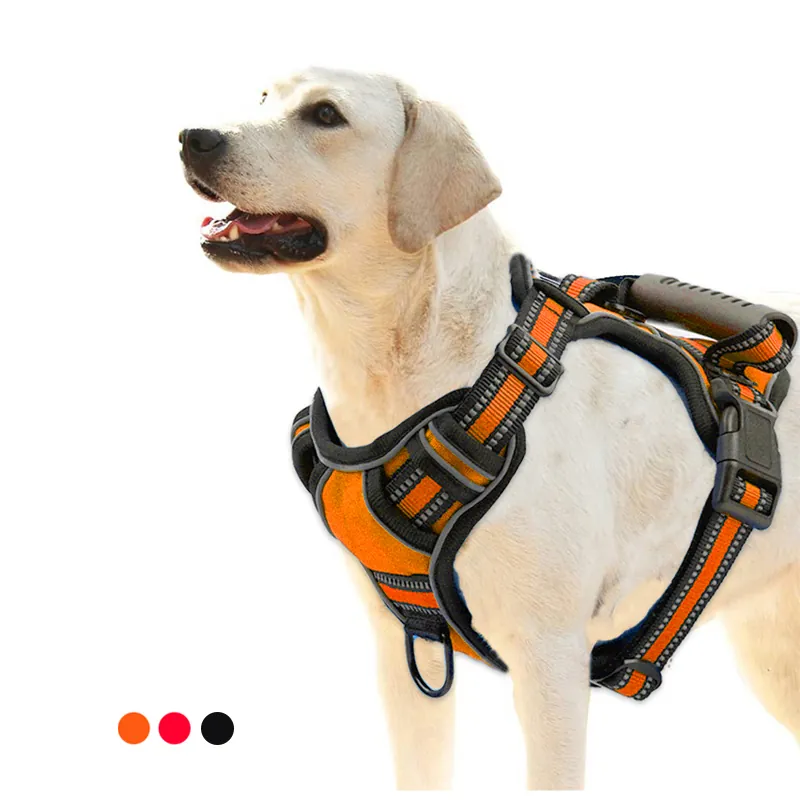 Our pickPadded reflective dog harnessPadded, reflective harness so your dogs are more visible in the eveningfrom $17.99See the product ›Sponsored
Which one should you choose?
If your dogs are just starting to walk together or one still pulls, begin with two separate leashes and add the hands-free leash to keep a hand free. Once both walk calmly at the same pace, a double leash simplifies outings. The padded reflective harness is useful in every case, especially for evening walks.
Frequently asked questions
Can I walk two dogs that both pull?
It's hard and risky. It's better to first teach each dog to walk without pulling, on its own. A dog trainer can help you get there faster. Don't use a double leash with dogs that pull.
Is a double leash a good idea?
Yes, for two well-trained dogs that get along, aren't reactive and walk at the same pace. For other dogs, two separate leashes are safer, according to the AKC.
My dogs pull in two different directions. What should I do?
Stop, wait for them to come back near you and reward them. Shorten the leashes and practise again somewhere calmer. If it continues, walk them separately while you train.
What leash length should I use for two dogs?
Whole Dog Journal suggests leashes no longer than six feet (about 1.8 m) and advises against retractable leashes.
Should I still walk each dog alone sometimes?
It's a good idea, according to the AKC: one-on-one walks let you train each dog and notice changes in its gait or behaviour more easily.
Sources
- Double Dog Leashes: When and How to Use Them Safely, American Kennel Club
- You Can Walk Two Dogs at Once, Whole Dog Journal
Find a service near you
Trainers & behaviorists Dog walkers and pet sitters Search by city