How to Walk Your Cat on a Harness
Updated : November 23, 2026
To walk your cat on a harness, you need a harness designed for cats (never just a collar), several days of reward-based practice at home, then very short outings in a quiet place where your cat chooses the direction and the pace. Let's be honest from the start: many cats dislike being restrained, and that is normal. Some learn to enjoy these outings, especially if they started young; others will always prefer to stay indoors.
Here is how to tell whether your cat is a good candidate, which harness to choose and how to train step by step, even when the Quebec winter delays the first outings.
Is it a good idea for your cat?
The major British cat welfare charities are cautious about it. Cats Protection, PDSA and Blue Cross all explain that most cats do not cope well with restraint: a cat likes to stay in control, choose where it goes and be able to run when something worries it. On a lead, it can no longer escape a car, a dog or a loud noise.
There is also an important difference with dogs. Blue Cross points out that a dog sees its person as its safe base, while a cat sees its territory as its safe base. Away from home, a cat can quickly feel overwhelmed.
That said, some curious and confident cats really enjoy supervised outings. Your cat is a better candidate if it:
- is curious, often watches outside and approaches new things without panicking;
- tolerates handling, including on its back and belly;
- is still young (it is easier to start with a kitten, according to Cats Protection);
- does not startle at every sound.
A fearful or older cat, or one that hides as soon as a visitor arrives, will often be happier in a well-designed home: a cat tree near a window, daily play, hiding spots. Our article How to Keep a Bored Indoor Cat Entertained has plenty of ideas.
Choosing the right harness
All three charities insist on the same point: a harness made for cats, never a collar. A collar can slip over the head, and pulling on the neck can choke a cat.
There are two main styles:
- Vest harness: it wraps around the chest and spreads pressure over a larger area. It is usually harder to wriggle out of, which is reassuring with an agile cat.
- Strap harness: lighter and less covering, it suits cats that dislike having something on their back.
For fit, the usual rule is being able to slide two fingers under the straps: snug enough that the cat can't back out, loose enough to move and breathe normally. Check that it doesn't rub behind the front legs. Choose a light leash, never a retractable leash that clicks and pulls constantly.
Getting used to it at home, step by step
This is the longest step and the one that decides everything. Allow several days, sometimes a few weeks. Cats Protection recommends progressing gradually and going back a step whenever the cat seems uncomfortable.
1. Leave the harness lying around. Put it near the food bowl or a favourite spot for a few days so your cat can sniff it and it picks up a familiar smell.
2. Pair it with good things. Show the harness, then give a reward. Repeat often, in short sessions.
3. Drape it without fastening. Lay it on your cat's back for a second, reward, remove. Very slowly increase the time.
4. Fasten it for a few seconds during a meal or a play session so your cat focuses on something else. Take it off before your cat protests.
5. Let your cat wear it for a few minutes at home while you play. It is normal for a cat to walk oddly or lie down at first: don't force it, wait for it to start moving again.
6. Add the leash, first without holding it, then following your cat around the house with the leash slack.
Never leave your cat alone wearing a harness, as it could get caught. Take it off at the end of each session, as Cats Protection recommends.
The first outings
Once your cat walks calmly in its harness indoors, you can try outside.
- Start very close to home: a yard, an enclosed balcony or a quiet corner. PDSA suggests trying a secure space before going out the front door.
- Avoid busy streets, dog parks and areas used by other cats.
- Let your cat decide. The leash is for safety, not steering. Follow, let your cat sniff, stop and watch.
- Keep it very short. Cats Protection suggests 5 to 10 minutes at first. A short, successful outing beats a long, stressful one.
- Pick your cat up or go home at the first sign of stress: flattened ears, low body, lashing tail, trying to flee or hide.
If a dog approaches, calmly pick up your cat and move away. A panicking cat may scratch or slip out of a poorly fitted harness.
What about winter in Quebec?
Winter is a great time to do all the training indoors, with no pressure. The first outings can wait for a mild day or for spring. Cold, wind, snow and road salt on sidewalks don't help a cat discovering the outdoors. If you do go out, pick a salt-free spot, stay out very briefly and wipe its paws when you get back.
Getting ready before you go out
A cat that slips out of its harness is in danger because it doesn't know the area. Before outings:
- make sure your cat is identified (Cats Protection recommends microchipping with up-to-date contact details);
- check the harness fit every time;
- keep a small reward in your pocket to call or praise your cat;
- use a carrier if you need to drive to a quiet place (see How to Travel by Car With Your Cat).
Cat harnesses from our selection
The best choice mostly depends on your cat's temperament:
- A vest harness with matching leash for most cats, since it covers the chest well and is harder to slip out of.
- A harness and leash with a bell if you want to hear where your cat is during backyard outings.
- A two-tone vest harness if you want a model that can also fit a very small dog in the household.
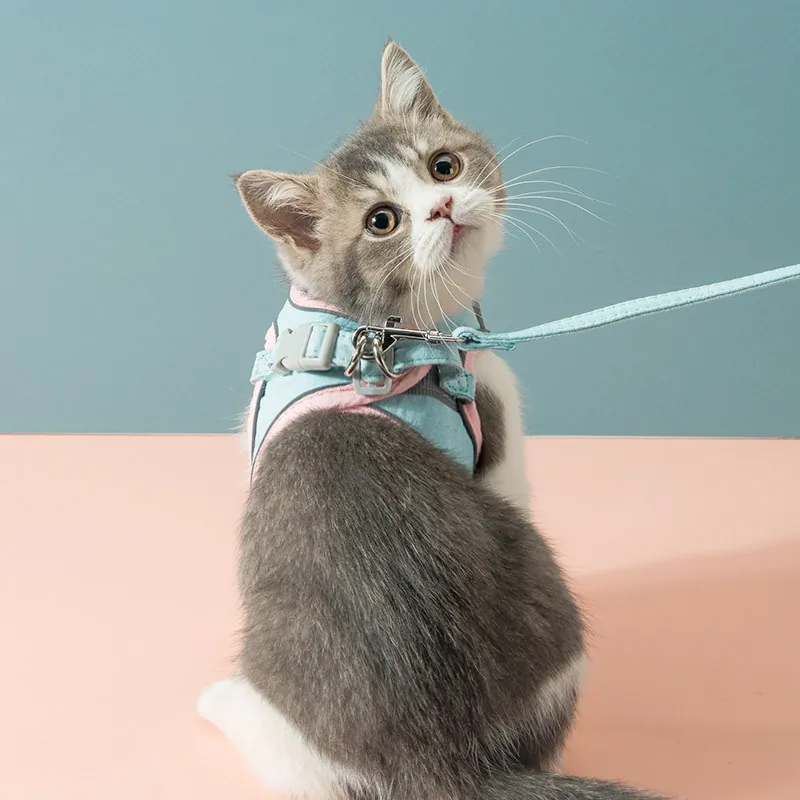 Our pickTwo-tone vest harness and matching leashTwo-tone vest harness and matching leash, another option for small buildsfrom $17.99See the product ›Sponsored
Which one should you choose?
For a first harness, the vest style is often the easiest: reassuring for you and spread across your cat's chest. The bell model is handy for a cat that likes to slip under bushes, but noise-sensitive cats may prefer a silent harness. Either way, measure the chest girth before ordering and check the fit with two fingers.
Frequently asked questions
Can every cat learn to walk on a harness?
No. Many cats dislike being restrained, and several charities advise against lead walking for most cats. A young, curious and confident cat is more likely to enjoy it. Never force a cat that resists.
How long does it take to get a cat used to a harness?
It varies a lot: a few days for some cats, a few weeks for others. Go at your cat's pace and step back as soon as it shows discomfort.
Can I use a collar and leash instead?
No. A collar can slip off and pulling on the neck can choke a cat. Always use a harness designed for cats.
My cat flops over as soon as I put the harness on. What should I do?
That's a common reaction at first. Distract your cat with play or a reward, keep the session very short and try again later. With repetition, most cats that accept a harness start walking again.
Do walks replace play at home?
No. Even a cat that enjoys its outings needs play, scratching posts and hiding spots at home. For an indoor cat, a stimulating environment remains the foundation, according to Cats Protection.
Sources
- Should I walk my cat on a harness and lead?, Cats Protection
- Walking a cat on a lead – is it a good idea?, PDSA
- Walking a cat, Blue Cross