How to Keep a Bored Indoor Cat Entertained
Updated : November 9, 2026
An indoor cat needs to hunt, climb, scratch, watch and hide, even if it never goes outside. Without chances to do so, it gets bored: it may yowl at night, ambush your ankles, scratch furniture or eat out of boredom. The good news is that a few play sessions a day and a better-arranged home often change everything.
Here is how to keep an indoor cat busy every day, based on advice from VCA Animal Hospitals and International Cat Care.
Signs of a bored cat
- It wakes you at night, yowls or races around in the evening.
- It "hunts" your feet or hands.
- It scratches furniture, knocks things over or chews plants.
- It sleeps a great deal and gains weight.
- It grooms excessively.
Some of these signs can also have a medical cause. A sudden change in behaviour is worth a vet visit.
Our picks
Well-known, highly rated toys and accessories.
Hunting play: the foundation
Cats are predators. Even well fed, they need to stalk, pounce and catch. VCA recommends several sessions of about 10 minutes a day, ideally at dawn and dusk, when cats are naturally most active.
For a good session:
1. Imitate prey with a feather wand: make it hide behind furniture, creep along the floor, freeze, then dart away.
2. Let your cat catch it several times. VCA stresses that cats need to succeed or they lose interest.
3. End with a catch, then offer a small treat or a meal: hunt, catch, eat, rest is the cat's natural cycle.
4. Follow its rhythm: short bursts of energy followed by rest are normal.
What about laser pointers?
Many cats love chasing the dot, but they can never catch it. If you use one, always end the session on a toy your cat can grab, such as a plush mouse, so it feels the hunt succeeded. Never shine it in the eyes.
Choosing toys
VCA describes several families of toys:
- Wands and teasers: the best for hunting play with you. Swap tips (feathers, cardboard, felt) for variety.
- Small toys: mice, crinkle balls, ping-pong balls, track toys where a ball spins in a circuit.
- Food puzzles: your cat bats or works the toy to get kibble, "hunting" part of its meal.
- Catnip: about half of cats do not react at all; it is genetic. Avoid it if it makes your cat agitated.
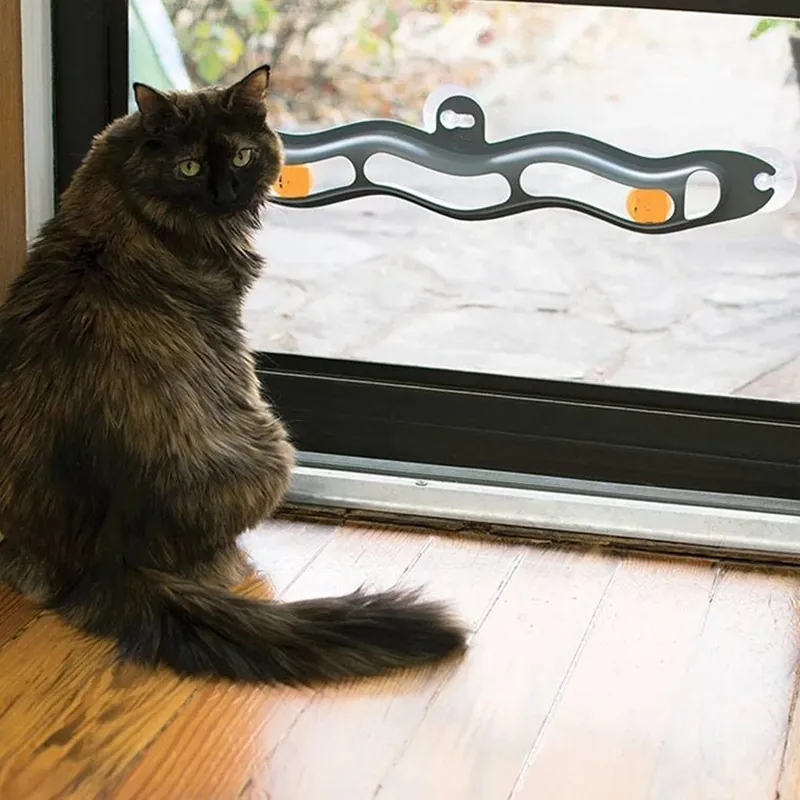 Our pickWindow ball track for catsSticks to the window for play in the sunfrom $16.99See the product ›Sponsored
Rotation is the secret
A toy that always lies in the same spot quickly gets boring. VCA suggests keeping about 20 toys, leaving out 4 or 5 at a time and swapping them every week. Store the rest in a closed container.
Safety first
- Put wands and strings away after play. A cat left alone with string can get tangled or swallow it, which can cause a serious intestinal problem.
- Watch small parts: feathers, bells, plastic eyes.
- Never play with your hands or feet. Your cat learns they are prey, and bites and scratches can become infected.
Arranging your home for a cat
Height
Cats feel safe up high. A cat tree, wall shelves or the top of a bookcase give them a lookout. VCA suggests placing the cat tree in a room where the family spends time, not a forgotten corner.
A window on the world
A window perch facing a bird feeder is many cats' favourite "TV". In Quebec, where indoor cats spend long winters inside, it is one of the most appreciated forms of enrichment. Make sure the screen is secure.
Hiding spots
A cardboard box, tunnel or covered bed gives your cat somewhere to retreat, which matters in a busy home with children or other pets.
Scratching posts
Scratching is a need, not a flaw. Read our article My cat is scratching the couch to choose and place scratchers well.
Exercise the brain
- Hide part of the kibble in several small bowls around the home, or in food puzzles. Make sure your cat still eats its full ration.
- Teach tricks with treats: coming when called, sitting, touching your hand with its nose. Yes, cats can learn!
- Try cat videos or apps: some cats love batting at virtual prey.
Safe outdoor time?
VCA mentions two options for indoor cats:
- An outdoor enclosure (a "catio"), attached to a window or door.
- Harness walks, introduced very gradually indoors with treats, then in a quiet area. Use a harness designed for cats.
What about a second cat?
A companion can help some sociable cats, but it is no miracle cure: many cats prefer to live alone, and a poor match creates stress. Talk to a shelter or your vet first. If you are considering adoption, our shelter and adoption listings can help.
Frequently asked questions
How long should I play with my cat each day?
VCA suggests several sessions of about 10 minutes a day, especially morning and evening.
My cat ignores every toy. What can I do?
Try a different texture or speed, play at dusk and move the prey like a real animal running away. Some cats prefer ground prey, others flying prey.
Can an indoor cat be happy?
Yes, if it has enough chances to hunt, climb, scratch, hide and watch, and play time with you every day.
My cat wakes me at night. Is it boredom?
Often, yes. A good play session followed by a meal before bedtime helps many cats sleep through the night.
Sources
- Cat Behavior and Training – Play and Play Toys, VCA Animal Hospitals
- Cat Behavior and Training – Enrichment for Indoor Cats, VCA Animal Hospitals
- Understanding the hunting behaviour of cats, International Cat Care