How to Choose a Cat Tree
Updated : November 10, 2026
To choose a cat tree, pick one that is stable first, tall enough for your cat to stretch fully on the scratching post, with perches big enough to lie down on, then put it in a room where the family spends time, ideally near a window. A tree that wobbles when the cat jumps, or has perches that are too small, often ends up ignored.
Here is how to compare models, which measurements to check, where to set it up and how to get your cat interested.
Why cats need height
Cats like to watch their territory from above. International Cat Care explains that cat trees and towers give cats both a climbing challenge and lookout perches. The Toronto Humane Society puts it simply: vertical space is not just fun, it is enrichment. It gives a cat a sense of control, lets it choose when to interact and gives it a place to retreat when it wants quiet.
That matters even more in a small apartment, a busy home with children, or when several pets share the space: your cat gains "floors" without you gaining square footage. For more ideas, read our article How to keep an indoor cat entertained.
Our picks
Well-known, highly rated products. Choose the size for your cat and your ceiling height.
The five things that really matter
1. Stability comes first
This is the most important point. The ASPCA recommends a sturdy scratching post that will not wobble, slide or collapse when the cat pulls on it. A cat that gets scared once because the tower tipped may never climb it again.
Check:
- The base: wide and heavy. The taller the tree, the bigger the base should be.
- The posts: thick, firmly screwed in, with no play.
- Wall anchoring: VCA Animal Hospitals advises anchoring any tall cat tree to the wall to prevent injury. Many models come with an anti-tip strap; use it.
2. The right height
International Cat Care says scratching posts should be as tall as possible so the cat can scratch vertically at full stretch. In practice, the scratching post should be longer than your cat standing on its hind legs with its front legs stretched up.
For overall height, think about your ceiling and your cat:
- Low tree (under 1 m / 3 ft): kittens, senior cats, small spaces.
- Medium tree (1 to 1.5 m / 3 to 5 ft): most adult cats.
- Tall tree (over 1.5 m / 5 ft): athletic cats, several cats, cats that love a high view. Wall anchoring is a must.
3. Perches and beds that are big enough
International Cat Care notes that beds on a cat tree should be large enough for the cat to rest comfortably, or it is less likely to use them. A large cat or a Maine Coon needs wide platforms and condos it can enter without squeezing. Measure your cat curled up and compare with the listed dimensions.
Mix it up: an open top perch for watching, a closed condo for hiding, a hammock for naps.
4. The right scratching material
Cats have preferences. The ASPCA lists cardboard, carpet, wood, sisal and upholstery; International Cat Care adds that some cats prefer to scratch horizontally, on a mat or corrugated cardboard. Sisal rope is the most common material on cat trees: it is durable and many cats like it.
If your cat mostly scratches the living room rug, it probably prefers horizontal surfaces: add a flat scratcher at the foot of the tree. If it goes for the side of the couch, it prefers vertical.
5. Easy upkeep
Choose removable, washable cushions and posts whose sisal can be replaced. Plush trees collect fur, so a quick vacuum once a week keeps them clean. Avoid small dangling parts that could easily be torn off.
Where to put it
Placement matters as much as the model. A cat gets more out of a tree in a room where the family lives than one tucked away in the basement, and the Toronto Humane Society recommends setting it near a window so the cat can watch birds, people and the weather.
Other good habits:
- Next to furniture it already scratches: the ASPCA advises placing scratchers where the cat naturally wants to scratch, beside the things you want to protect. See also My cat scratches the couch: what to do.
- A path up high: VCA suggests linking high spots with wall shelves, for example from the top of a bookcase to the cat tree.
- A clear landing zone: no ornaments, cords or unscreened open windows within jumping range.
One cat or several?
With several cats, height helps prevent tension. International Cat Care recommends at least one of each resource per cat, plus one, spread apart. For cat trees, that means several high perches at different levels, or two trees in different rooms. VCA reminds owners that shared shelves must hold the weight of more than one cat at once. Beds with two entrances keep one cat from being cornered by another.
Kitten or senior cat: adjust your choice
For a kitten, a low tree with hanging toys and closely spaced levels is enough at first; it can climb higher as it grows.
For a senior cat, International Cat Care suggests shallow steps or a gentle ramp to reach favourite spots, and horizontal scratchers, which are easier on stiff joints than tall vertical posts. A tree with low, wide, padded platforms is a safer choice. Cats that lose some balance also appreciate a cushion below narrow ledges.
Getting your cat to use it
A new tree is not always a hit right away. A few tips based on ASPCA advice:
1. Rub catnip on the post and platforms.
2. Hang a toy from the post or play with a wand toy around the tree.
3. Place a treat or its blanket on the top perch.
4. Praise your cat every time it scratches the tree instead of the couch.
5. Do not replace a worn post too quickly: the ASPCA notes cats often prefer familiar, shredded surfaces that carry their scent.
Give it a few days. Do not force your cat onto the tree; let it explore at its own pace.
Tree, shelves or a simple scratcher?
If space is very tight, International Cat Care suggests scratching panels attached to the wall at the right height. Wall shelves free up the floor, but they need a non-slip surface, since varnished wood is slippery. A flat cardboard scratcher is inexpensive and many cats love it. The best setup often combines one main tree with one or two scratchers elsewhere in the home.
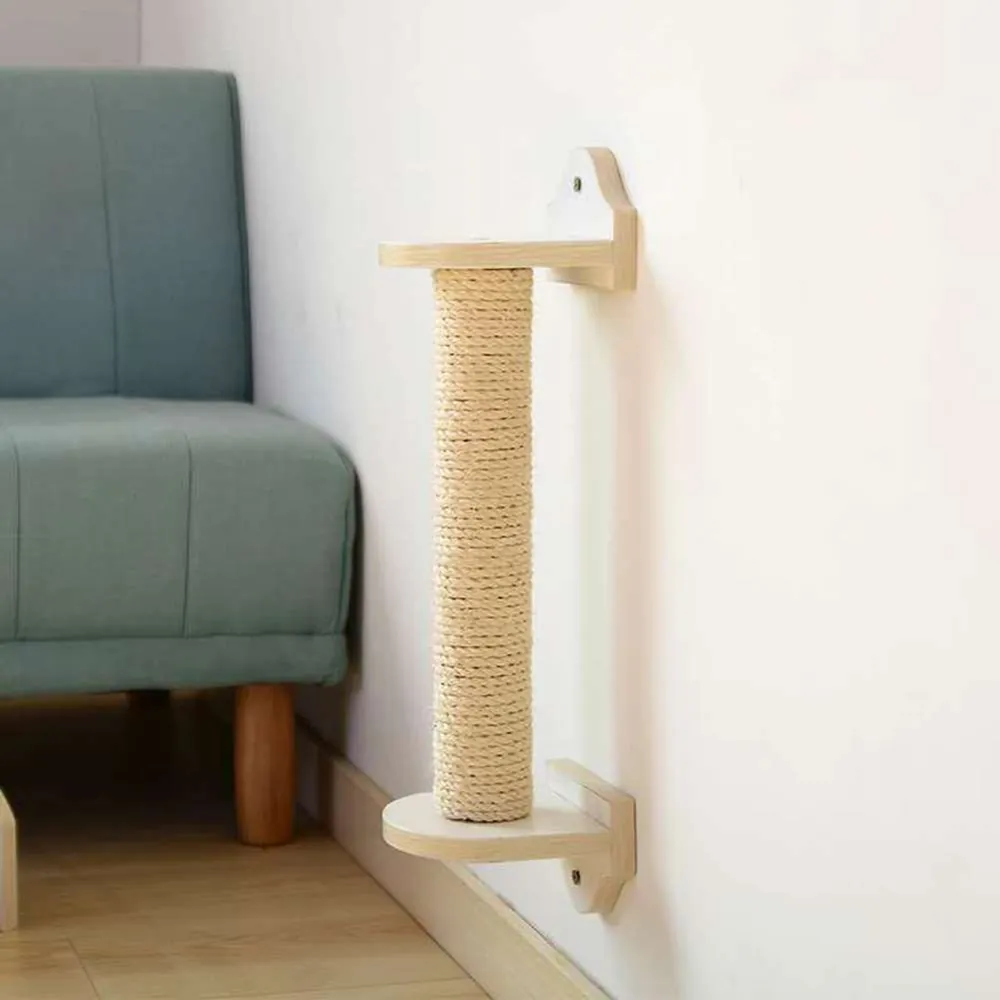 Our pickWall or floor sisal scratcherA sisal scratcher for the wall or the floorfrom $30.39See the product ›Sponsored
Frequently asked questions
How tall should a cat tree be?
For most adult cats, 1 to 1.5 m (3 to 5 ft) is enough. What matters most is that the scratching post allows a full stretch. Above 1.5 m, anchor the tree to the wall.
My cat ignores its new tree. What should I do?
Move it, ideally near a window or the furniture it scratches, and add catnip and play sessions around it. Also check that it does not wobble when the cat jumps.
Do I need one tree per cat?
Not necessarily, but there should be enough high perches for each cat to have its own without competing. Two trees in different rooms often work better than one big one.
How long does a cat tree last?
Several years if it is well built. The sisal wears out first: choose a model where it can be replaced, and leave some wear, which cats like.
Sources
- Making your home cat friendly, International Cat Care
- Special considerations for senior cats, International Cat Care
- Destructive Scratching, ASPCA
- How to Make Vertical Space for Cats, VCA Animal Hospitals
- Vertical Space for Cats, Toronto Humane Society