How to Cat-Proof Your Christmas Tree
Updated : November 14, 2026
To cat-proof your Christmas tree, start by making sure it can't fall (a sturdy stand plus an anchor to the wall or ceiling), then make the bottom of the tree boring: nothing fragile or dangling within reach, no tinsel, the stand water covered and cords out of the way. Add a more appealing place to climb and watch the room, and most cats eventually leave the tree alone. Both the ASPCA and VCA Animal Hospitals list a securely anchored tree as the first rule.
To a cat, a Christmas tree is an indoor tree full of shiny toys that move. Climbing it isn't bad behaviour: it's exactly what cats do. So the goal isn't to punish your cat, but to arrange the space so the tree is less tempting and the rest of the house is more interesting.
Before you set up the tree
Real or artificial?
Both can work with a cat. A real tree has its charms (the smell, the tradition), but it drops needles and needs a water reservoir, two things that attract curious cats. Humane World for Animals notes that swallowed needles can cause problems and that stand water can contain harmful chemicals. An artificial tree solves both issues, but it still needs to be secured, and small decorative pieces still need watching.
Size and shape
If your cat is young, a keen climber or spending a first Christmas with you, a smaller or slimmer tree is easier to stabilize. Some families start with a small tree on a solid piece of furniture the first year, just to see how the cat reacts.
Our picks
Two purchases that solve the two real problems: a tree that could fall, and a cat that needs another place to climb and scratch.
The stand and the anchor
A four- or five-kilo cat leaping into the branches can tip over a poorly secured tree. What helps:
- A wide, heavy stand: it lowers the centre of gravity and grips the trunk firmly. Stands with several clamping points hold better than a single screw ring.
- An anchor: tie the top of the trunk to a hook screwed into the wall or ceiling with clear fishing line or strong twine. It's nearly invisible, and it's what really prevents a fall.
- A corner of the room: two nearby walls limit the angles of attack and give support if the tree gets bumped.
Pick the right spot
Look at your living room through your cat's eyes. A couch, bookcase or side table next to the tree is a launch pad. Leave about a metre of space between the tree and any furniture your cat likes to jump on.
Also avoid putting the tree in front of a favourite window or on the way to the food bowl or litter box, which would put temptation in your cat's path every day. A slightly out-of-the-way but visible corner works best.
A useful trick: set the tree up bare for a day or two before decorating. Your cat will explore it, sniff it and maybe try a first climb. Once the novelty wears off, many cats are less interested when the ornaments go on.
Decorate wisely
Keep the bottom boring
The area your cat can reach standing on its hind legs (roughly the first metre) should stay calm. Humane World for Animals recommends keeping lights and tinsel away from the bottom of the tree. In practice:
- No glass or fragile ornaments down low. The ASPCA warns that broken ornaments can injure a pet's mouth and paws.
- Nothing that dangles and sways in a draft: that's a perfect cat toy.
- Fabric, wood or shatterproof ornaments can go lower if you want the tree decorated all the way down.
Hooks and hangers
Small metal hooks fall off and get lost in the carpet. Tie ornaments on with a tightly knotted ribbon loop instead, or pinch hooks closed with pliers so they stay on the branch.
Skip tinsel, ribbon and string
VCA and the ASPCA are clear: tinsel, ribbon and string are among the riskiest decorations for cats, who love to chew them. With a cat at home, the simplest solution is not to use them at all, on the tree or on gifts. Swap them for felt or wooden garlands, which are heavier and less tempting.
Lights and cords
Place lights higher up and closer to the trunk, and run cords behind the tree along the wall. Tuck extra cord into a box or cord cover and unplug the lights when you're not home. Lit candles don't belong near a tree with a cat around: use battery-powered ones.
Stand water and needles
With a real tree, cover the reservoir. A snug tree skirt, a lid cut from cardboard or a ring of fine mesh around the trunk keeps your cat from drinking it. Use plain fresh water with no additives, and vacuum fallen needles often.
For seasonal plants (poinsettia, mistletoe, holly, amaryllis, lilies), see our article on toxic Christmas plants for cats and dogs. And if you think your cat swallowed a decoration, call your veterinarian right away.
Make the tree less interesting than everything else
A bored cat looks for something to do. In December the house changes, there are visitors and noise: it's the right time to offer something better than the tree.
- Another place to climb: a cat tree or a window shelf gives height, which is what your cat was looking for in the Christmas tree. See our guide on how to choose a cat tree.
- A vertical scratching post: placed near the tree, it gives your cat a place to scratch and stretch. Reward every use.
- Play sessions: two short sessions a day with a feather wand burn off energy. A tired cat climbs less.
- A quiet room: during gatherings, Humane World for Animals suggests offering your pet a calm room. A cat stressed by guests may hide under or inside the tree.
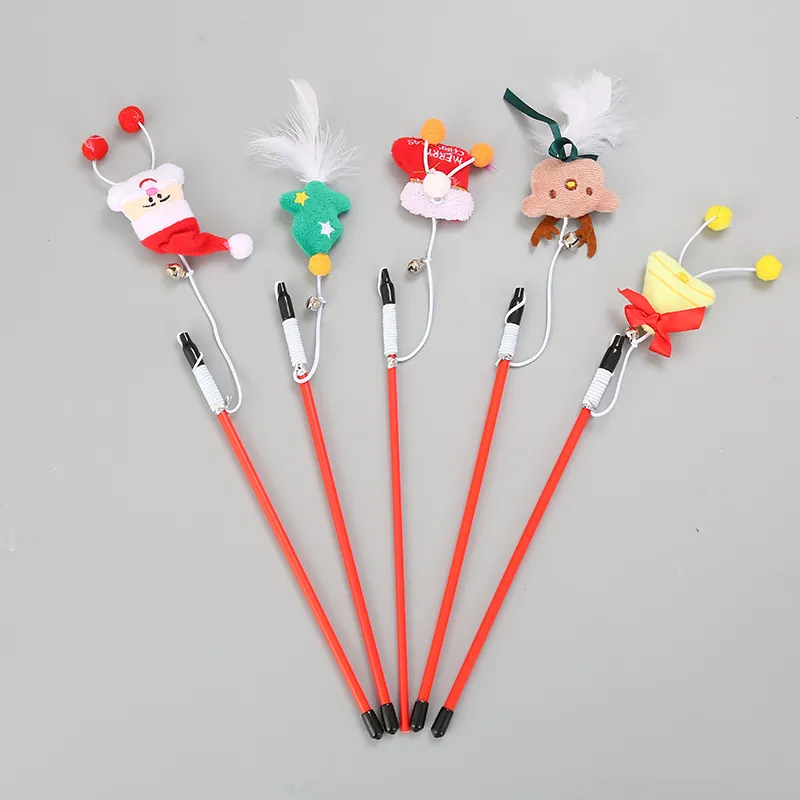 Our pickChristmas cat wandFor playtime away from the treefrom $14.99See the product ›Sponsored
Gentle deterrents
Some people lay aluminum foil or a slightly prickly furniture mat around the base: many cats dislike walking on them. Citrus scents also put off many cats, but never use concentrated essential oils near them. Avoid water sprays and yelling: your cat mostly learns to fear you, not to avoid the tree.
If your cat climbs anyway
Stay calm. Lift your cat down gently, without scolding, and redirect right away to the cat tree or a toy. Notice what draws your cat in (a swaying ornament, a low branch, nearby furniture) and fix it. If nothing works, there's always a simple option: close the door to that room when you're out, or set the tree up in a room your cat doesn't use.
The first year with a kitten is often the hardest. Adult cats usually lose interest after a few days, especially when the tree is stable and nothing moves at the bottom.
Frequently asked questions
How do I stop my cat from climbing the Christmas tree?
Keep the bottom of the tree boring (nothing that moves), move furniture that acts as a springboard and offer a cat tree instead. Anchor the tree to the wall so it can't fall if your cat climbs anyway.
Is an artificial tree better with a cat?
It avoids needles and stand water, which makes things simpler. It still needs to be well secured, and small ornaments still need watching.
Should I avoid tinsel with a cat?
Yes. The ASPCA and VCA list it among the riskiest decorations for cats. Use felt or wooden garlands instead.
My cat drinks the tree water. What should I do?
Cover the reservoir with a snug tree skirt or a lid, and don't add anything to the water. Offer fresh water elsewhere, such as a fountain.
Sources
- Holiday Safety Tips, ASPCA
- Holiday Safety Tips for Cat Owners, VCA Animal Hospitals
- Holiday safety tips for pets, Humane World for Animals