Best Toys for Dogs That Destroy Everything
Updated : November 14, 2026
For a dog that destroys everything, choose thick natural rubber toys that are too big to fit entirely in the mouth, with no eyes, ribbons or parts that can come off, and save plush toys for times when you are watching. Add food-stuffed toys, rotate toys every week and throw away any toy that starts breaking into pieces.
Why some dogs destroy all their toys
Chewing is normal dog behaviour. According to the ASPCA, dogs chew to keep their jaws strong, clean their teeth, pass the time and relieve mild anxiety or frustration. Puppies also chew to ease teething.
Some dogs simply have powerful jaws and a strong need to chew: retrievers, shepherds, bull terriers and many working breeds are known for it, but a small dog can be a champion destroyer too. VCA Animal Hospitals point out that every dog has its own drive to destroy, and some can take apart a rubber toy within minutes.
Then there is the bored dog. A dog that lacks exercise or stimulation often turns its energy on whatever it finds: toys, cushions, shoes, baseboards. In that case, no toy will be enough until those needs are met.
Our picks
Here are three toys known for their toughness, each for a different style of destroyer.
What kind of destroyer do you have?
Watch your dog for a few days. The way it plays tells you which toy to choose.
- The chewer lies down with the toy and gnaws for a long time with its back teeth. It needs dense, thick rubber.
- The shredder shakes, pulls and rips open plush toys to get the stuffing and squeaker out. It needs stuffing-free toys, reinforced fabric or sturdy tug toys.
- The chaser wants to run after a ball or disc, then bite down hard. It needs a solid rubber ball of the right size.
- The forager works hardest when food is involved. Stuffable toys and puzzles will keep it busy for a long time.
Materials that hold up
Thick natural rubber
This is the safe bet for power chewers. Humane World for Animals (formerly the Humane Society of the United States) considers very hard rubber toys, of the KONG type, a safer and longer-lasting option. The "extreme" or "ultra" versions from major brands use denser rubber than the classic models. Bonus: many can be stuffed with food, turning the toy into an activity.
Soft but tough synthetic materials
Some brands make toys from a soft but very tough synthetic material that is gentler on teeth than hard rubber. Several offer a replacement guarantee if the dog breaks one.
Reinforced, stuffing-free fabric
For the shredder that loves plush toys, look for thick canvas toys with double stitching, or stuffing-free plush. There is nothing to pull out and swallow, and the dog can shake the toy as much as it likes. No fabric is indestructible, but a dog that finds no stuffing often gives up sooner.
Rope
Braided rope toys are great for tug games. Keep an eye on them: once they fray, the threads can be swallowed. VCA recommends throwing away frayed rope.
The fingernail test: not too hard, not too soft
A toy that is too hard can damage teeth. VCA Animal Hospitals suggest a simple test: you should be able to dent the toy's surface slightly with your fingernail, and a long toy should bend a little between your hands. They advise against very hard items such as bones, hooves and antlers, which can chip or break a tooth.
Tennis balls are fun for fetch, but VCA notes that their rough surface wears teeth down when a dog chews them constantly, and Humane World adds that dogs can chew through them and create a choking hazard. Keep them for games, not for chewing alone.
Choosing the right size
Size matters as much as material. VCA recommends a toy too large to fit entirely in the mouth: a small toy increases the risk of it being swallowed or getting stuck in the throat. The American Kennel Club (AKC) gives the same rule for balls: a small dog should be able to pick it up but not swallow it, and a large dog needs a ball big enough not to choke on.
When in doubt between two sizes, go bigger. And remember to size up as a puppy grows.
What to avoid
- Eyes, ribbons, strings and bells sewn onto toys: Humane World and VCA warn they can be torn off and swallowed.
- Toys stuffed with polystyrene beads or nutshells.
- Old shoes or cushions given as toys: the ASPCA explains this confuses the dog, which cannot tell the allowed old shoe from the new one.
- Children's toys, often too small and full of tiny parts.
- Squeakers without supervision: many dogs work hard to dig them out, and Humane World recommends watching playtime.
Making toys last: rotation
A dog with twenty toys lying around gets bored and destroys them. Humane World suggests rotating toys weekly, leaving only a few out at a time. The ASPCA suggests introducing new toys or swapping them every couple of days. The AKC adds that a toy put away for a while feels new when it comes back.
In practice:
1. Keep three or four toys of different kinds out (one to chew, one to stuff, one for tug, one ball).
2. Store the rest in a closed bin.
3. Swap them every week, or more often if your dog loses interest.
4. Inspect each toy when you swap, and throw out any that loses pieces, frays or shows stuffing.
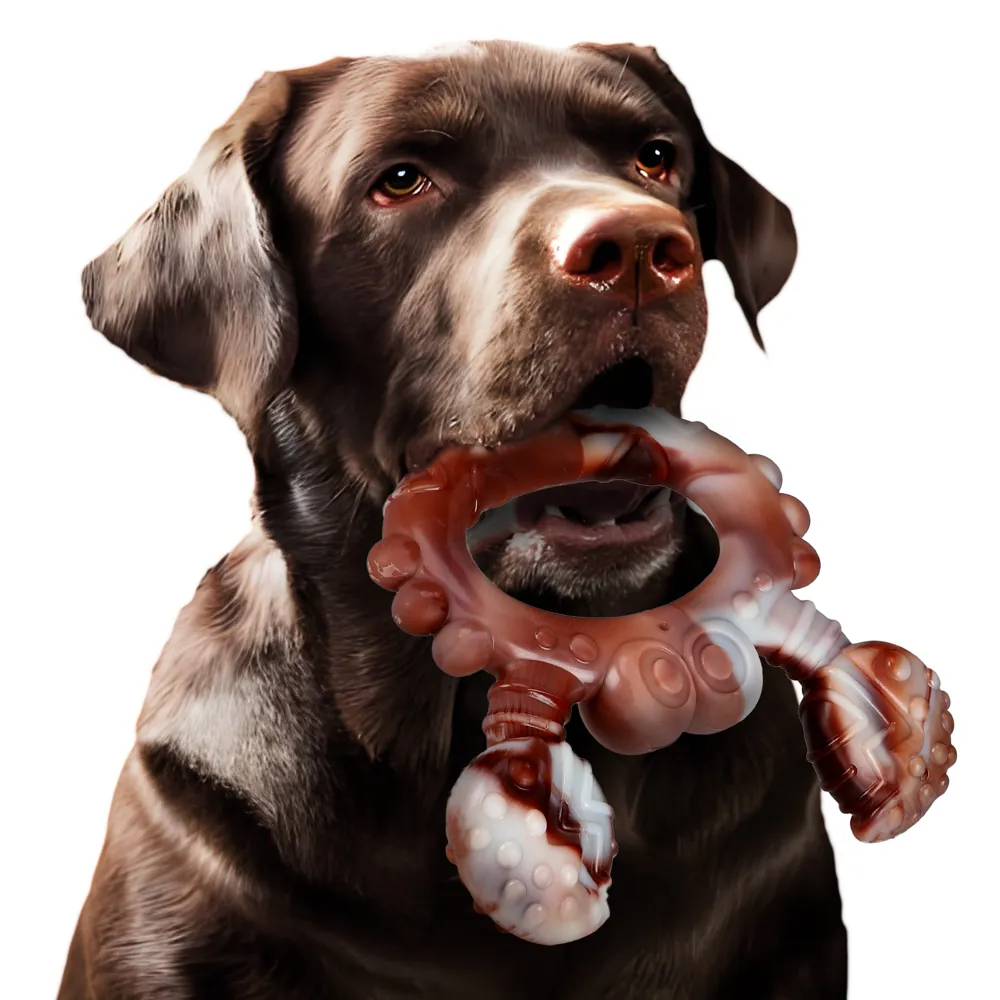 Our pickNylon chew toys, single or multi-packNylon chews, single or in a setfrom $16.99See the product ›Sponsored
Stuffable toys: the secret weapon
A rubber toy stuffed with food keeps a chewer busy far longer than an empty toy. The ASPCA recommends putting part of your dog's daily meals inside, especially at the times of day when it tends to chew. To make it last longer, fill it with soaked kibble or its usual food and freeze it the night before.
Puzzles and snuffle mats are great add-ons too: they tire the brain as much as the jaw. Our guide on keeping a dog busy home alone has plenty of ideas.
Reducing the need to destroy
The best toy does not replace a full day. The ASPCA notes that daily walks, play with people and other dogs, training and dog sports reduce boredom chewing. Tire your dog out before leaving it alone for a long stretch.
A few more ideas:
- Put temptation away: shoes in the closet, clothes in the hamper, books on shelves.
- Redirect calmly: if you catch your dog chewing something off-limits, take it away without yelling, offer an allowed toy and praise it when it takes it.
- Never punish after the fact: the ASPCA explains the dog cannot connect it with something done earlier.
If your dog destroys things mostly when alone, and whines, barks, paces or soils the house while you are away, the ASPCA says it may be separation anxiety. A trainer or behaviour professional can help: this is not something a toy will fix on its own. You will find professionals in our training and behaviour section.
Frequently asked questions
Is there a truly indestructible dog toy?
No. No toy survives every dog. Some last months, others a few days, depending on the jaw. Inspect toys often and throw out any that lose pieces.
My dog swallowed a piece of toy. What should I do?
Call your veterinarian right away to find out what to do, especially if the piece is large or sharp, or if your dog vomits or seems unwell. Do not try to make your dog vomit on your own.
Can I leave a toy with my dog when it is alone?
Yes, if it is sturdy, the right size and has no detachable parts, like a stuffed rubber toy. Keep plush, rope and squeaky toys for when you are around.
How many toys does a destructive dog need?
Three or four different kinds at a time are enough, with a stored reserve for weekly rotation. A few sturdy toys beat many fragile ones.
Sources
- Destructive Chewing, ASPCA
- How to choose the best chew toy for your dog, VCA Animal Hospitals
- How to pick the best and safest dog toys, Humane World for Animals
- Which Dog Toys Are Right for Your Dog?, American Kennel Club
Find a service near you
Pet food & supply stores Trainers & behaviorists Search by city